How to Find Yourself When You Feel Lost
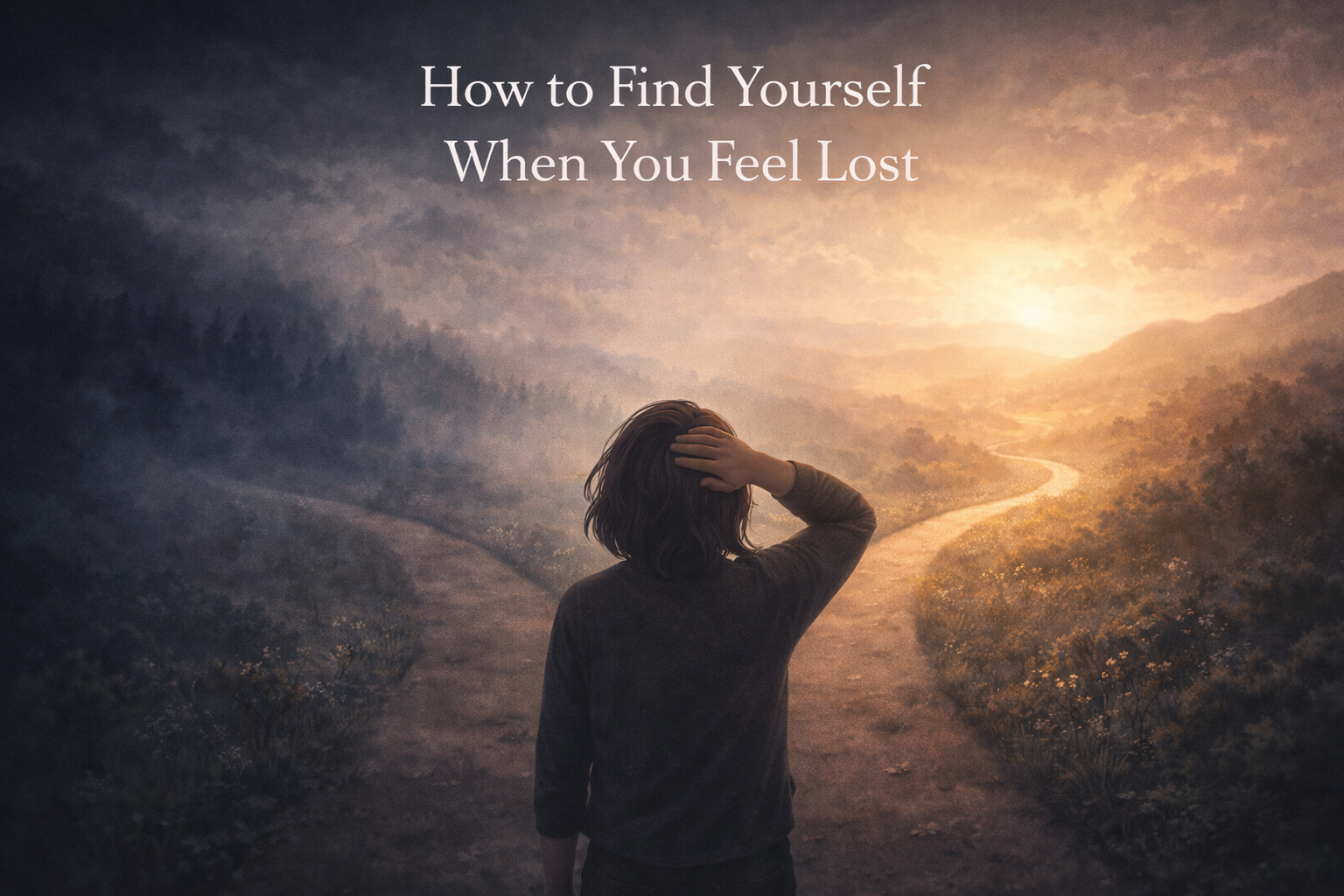
There are times in life when you can no longer tell what is true for you and what has simply become familiar.
You keep going. You answer people, finish tasks, and show up where you are needed. From the outside, everything may look normal. Inside, though, something feels off. You may feel disconnected from your own voice, unsure of what you want, or tired in a way that rest does not fully fix.
Feeling lost can be unsettling because it touches more than one part of life at once. It affects your sense of direction, your energy, your relationships, and often your trust in yourself. Still, being lost is not always a sign that something is wrong. Sometimes it is the beginning of a more honest life.
If you have been wondering about how to find yourself in life, it helps to know that this process is rarely dramatic. More often, it begins quietly, with the decision to stop abandoning what you feel.
A Gentle Place to Start: Everything Is You by Olivia House
For readers moving through inner confusion or emotional change, Everything Is You by Olivia House offers a thoughtful place to begin.
This is not the kind of book that rushes you toward a polished version of yourself. It speaks more gently than that. Its message centers on awareness, suffering, healing, and the relationship you have with your own inner world. That makes it especially meaningful for people who feel disconnected from themselves and want something deeper than quick advice.
What stands out about Everything Is You is its honesty. It invites reflection without pushing for performance. For anyone interested in finding themselves again, it offers a perspective that feels calm, sincere, and rooted in real inner work.
What It Really Means to Feel Lost
Feeling lost is not always about lacking a plan. Sometimes it is about losing contact with your own inner truth.
You can feel lost after heartbreak, burnout, grief, a major life transition, or years of living according to other people’s expectations. You can also feel lost when the life you built no longer matches who you are becoming.
That kind of disconnection can show up in small ways. You stop knowing what you really want. Decisions become harder. Things that once mattered no longer feel meaningful. You may feel numb, restless, emotionally flat, or pulled in too many directions at once.
Often, feeling lost is not the absence of self. It is the result of too much noise around the self.
Why We Drift Away From Ourselves
Most people do not lose themselves all at once. It happens gradually.
You adapt to keep the peace. You become who others need you to be. You learn to perform strength, stay agreeable, suppress emotion, or keep moving so you do not have to look too closely at what hurts. Over time, these patterns can become so normal that you stop noticing how far you have drifted from your own center.
Sometimes the drift begins in survival. Sometimes it begins in people-pleasing. Sometimes it comes from old fear, repeated disappointment, or the pressure to live up to a role that no longer fits.
This is why rediscovering yourself is not about inventing a new identity from scratch. It is often about clearing away what was never truly yours to begin with.
That can include outside expectations, inherited beliefs, self-protective habits, and the versions of yourself you created just to get through.
How to Find Yourself in Life Without Forcing It
One of the hardest parts of self-discovery is that it does not respond well to pressure.
When people feel lost, they often want immediate clarity. They want a life purpose, a new plan, a certain answer, a version of themselves they can trust right away. But growth usually does not work like that. The more you demand certainty, the more likely you are to miss the quieter truths trying to emerge.
Learning how to find yourself in life begins less with doing and more with listening.
Listening to what feels heavy.
Listening to what no longer feels true.
Listening to what your body tightens around.
Listening to the parts of your life that leave you feeling drained, disconnected, or inwardly divided.
Silence matters here. Honesty matters too. Not dramatic honesty, just simple truth. The truth that says, “This no longer feels right.” Or, “I have been living from habit, not alignment.” Or, “I do not fully know who I am right now, but I know I cannot keep pretending.”
That kind of honesty creates space. And space is often where finding your true self begins.
5 Gentle Ways to Begin Rediscovering Yourself
1. Get honest about what no longer feels true
You do not need to have your whole life figured out. Start smaller.
What conversations leave you feeling unlike yourself? What commitments feel empty? What beliefs are you carrying because they were handed to you, not chosen by you?
Often, finding yourself again begins with noticing what no longer belongs.
2. Spend time away from constant noise.
It is hard to hear yourself clearly when your attention is always being pulled outward.
Time away from noise does not have to mean disappearing from your life. It can be as simple as a quiet walk, a few minutes without your phone, a journal page in the morning, or sitting with your thoughts without immediately distracting yourself.
Silence can feel uncomfortable at first. Then it starts to reveal things.
3. Notice what brings a sense of aliveness.
Pay attention to the moments when you feel most like yourself, even briefly.
It might happen while writing, creating, being in nature, having an honest conversation, reading something that opens you, or doing work that feels meaningful. These moments matter. They are often small clues pointing back to what is real for you.
When rediscovering yourself, aliveness is one of the most trustworthy guides.
4. Stop measuring yourself by old versions of you.
Sometimes people feel lost because they are trying to return to a version of themselves that no longer fits.
You may not be meant to go back. You may be meant to grow into someone quieter, clearer, softer, stronger, or more truthful than you were before.
Letting go of old self-definitions is part of finding your true self. Not every previous identity deserves to be restored.
5. Let clarity arrive slowly
Not everything meaningful shows up all at once.
Sometimes clarity comes in fragments. A realization here. A boundary there. A growing awareness that one part of your life feels aligned and another does not. This is still progress.
You do not need to force a grand breakthrough. Slow truth is still truth.
Finding Your True Self in Everyday Life
Self-discovery is not only something that happens in reflection. It also happens in daily choices.
You find yourself when you stop saying yes to what keeps harming you.
You find yourself when you speak more honestly.
You find yourself when you notice what you need instead of dismissing it.
You find yourself when you stop shaping your life around constant approval.
This is what finding yourself again can look like in real life. It is not always dramatic. It may be a quieter way of living, but it is often more real.
Over time, your true self becomes less of an idea and more of a lived experience. You trust your inner responses more. You stop reaching outside yourself for every answer. You begin to recognize what is yours and what never was.
That recognition changes the way you move through life.
Conclusion
If you feel lost, it does not mean you have failed. It may simply mean that something false is falling away, and something more honest is asking to be heard.
There is no shame in not knowing exactly who you are right now. Many people arrive at deeper self-understanding through confusion, exhaustion, grief, or change. The important thing is not to force certainty before it is ready. The important thing is to stay close enough to yourself to notice what is true.
That is how rediscovering yourself begins.
And if you want a thoughtful companion for that process, Everything Is You by Olivia House is a meaningful place to turn. Its message around awareness, healing, and inner truth speaks gently to anyone learning how to come back to themselves.