What to Do When You Feel Stuck in a Negative Thought Loop
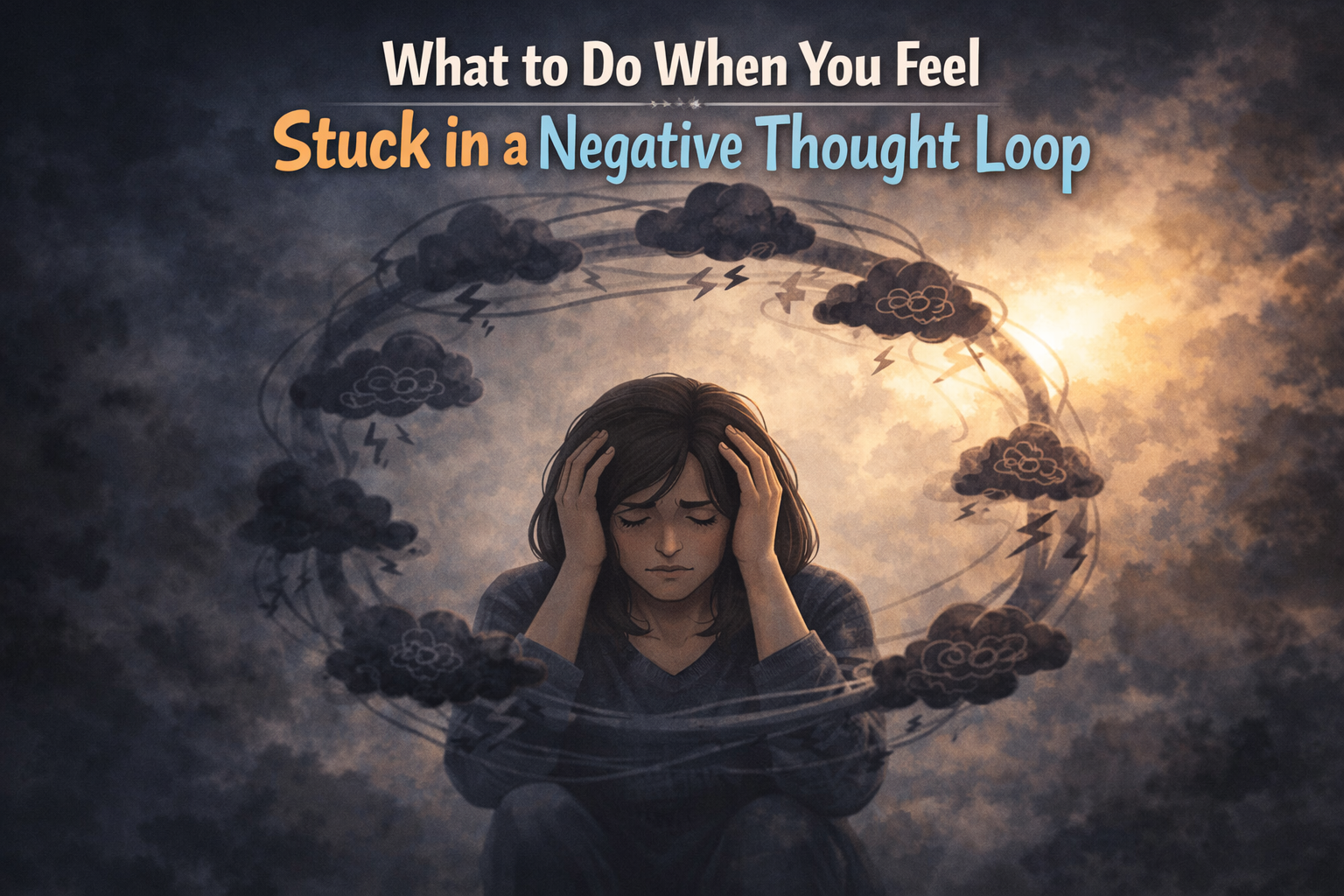
There are moments when the mind will not let go.
You replay the same conversation. You imagine the worst outcome. You tell yourself the same painful thing in slightly different words until it starts to feel like the truth. By the time you notice what is happening, your mood has changed, your body feels tense, and the thought has pulled you into a place that feels hard to leave.
If that feels familiar, you are not alone. Many people spend more time than they realize trapped in repetitive thinking. It can look like worry, self-doubt, regret, fear, or an endless internal argument that never really settles. And when it keeps happening, it can leave you exhausted.
The good news is that change usually does not begin by forcing your mind into silence. It begins by understanding what is happening with a little more honesty and a little less panic. That is often the first real step in stopping negative thoughts and finding your way back to yourself.
A Thoughtful Resource for Inner Healing: Everything Is You by Olivia House
Before going deeper, it is worth mentioning a book that fits this subject in a meaningful way.
Everything Is You by Olivia House speaks to the inner world with a quiet kind of clarity. It is not written like a productivity book or a set of quick mental tricks. It is more reflective than that. The book explores suffering, awareness, and the patterns that shape how we experience life.
For readers who feel caught in repetitive thoughts, emotional overwhelm, or inner heaviness, it offers something steady. It invites you to look at your mind without becoming lost in it. That makes it a valuable read for anyone who wants to understand their reactions more deeply and begin shifting the inner habits that create suffering.
Why Negative Thought Loops Happen
Negative thought loops do not appear out of nowhere. They usually form where emotion, memory, and habit meet.
Sometimes a thought begins with something small. A text goes unanswered. A mistake happens at work. Someone says something that touches an old wound. The mind reacts quickly, often before you have fully noticed it. Then it builds a story around the moment.
You start with one thought, but it rarely stays there. It turns into five, then ten. The mind searches for evidence, fills in blanks, predicts what happens next, and tries to protect you by staying alert. The problem is that this kind of protection often feels like suffering.
That is why how to deal with negative thoughts is not really a question about thinking alone. It is also a question about fear, emotional memory, and the old beliefs that become active when something feels threatening.
A thought becomes powerful when it touches something tender in you. That is why the same situation can affect two people very differently. One person shrugs it off. Another spiral for hours. The difference is often not the event itself, but what it awakens internally.
The Difference Between a Thought and Your Identity
One of the most important shifts in overcoming negative thoughts is learning that a thought is not the same thing as who you are.
This sounds simple, but it changes everything.
A negative thought might say, “I always ruin things.” Or, “No one really cares.” Or, “I will never get better.” The danger is not only in hearing the thought. The danger is in believing it completely and building your identity around it.
Thoughts come and go all day long. Some are useful. Some are distorted. Some come from fear. Some are echoes of old pain. The mind produces them constantly. But not every thought deserves your loyalty.
When you are stuck in a negative loop, it can feel as though the thought is telling the truth simply because it is loud or repeated. Repetition is powerful. The mind often mistakes familiarity for accuracy.
But you are not every thought you think. You are the one noticing the thought.
That small distinction creates breathing room. It means you can witness what the mind is doing without immediately becoming it.
How to Deal With Negative Thoughts Without Making Them Stronger
Many people try to get rid of painful thoughts by fighting them. It makes sense. If a thought hurts, you want it gone. So you argue with it, suppress it, distract yourself from it, or judge yourself for having it in the first place.
Usually, that makes it stronger.
Part of learning how to deal with negative thoughts is realizing that resistance often feeds the cycle. The thought shows up. You tense against it. That tension gives it more energy. Now you are not only having the thought, but you are reacting to it with fear.
A gentler approach is often more effective.
Instead of trying to crush the thought, notice it. Name it. Let it be present without treating it like a command. This does not mean agreeing with it. It means seeing it clearly enough that it stops controlling the whole room.
For example, instead of collapsing into “I am failing,” you might quietly notice, “I am having a fear-based thought about failing.” That shift may sound subtle, but it breaks the spell. It moves you from fusion to awareness.
Emotional honesty matters here, too. A thought loop is often sitting on top of a feeling that has not been fully acknowledged. Underneath the worry may be shame. Underneath the self-criticism may be grief. Underneath the anger may be hurt.
Sometimes the thought is not the deepest issue. It is just the surface noise around an emotion asking to be felt.
What Stopping Negative Thoughts Really Looks Like
The phrase stopping negative thoughts can be misleading. It makes it sound as though healing means reaching a place where the mind never goes dark again. That is not a realistic goal.
A human mind will always produce difficult thoughts from time to time. Stress, fatigue, grief, uncertainty, and old pain can all stir them up. The aim is not perfection. The aim is a different relationship with what appears.
You do not need to become thoughtless. You need to become less entangled.
That is what real change often looks like. The thought still arises, but it does not pull you under so quickly. You notice it earlier. You take it less personally. You give it less authority. You recover faster.
This is also what people often mean when they want to get rid of negative thoughts. They do not always want every difficult thought to vanish forever. They want relief from being consumed by them.
That relief usually comes through awareness, practice, and a growing ability to return to the present instead of feeding the loop.
5 Gentle Ways to Interrupt a Negative Thought Loop
1. Name the thought without obeying it
Try putting simple language around what is happening.
You might say, “This is a fear loop.” Or, “This is my mind predicting rejection.” Naming it creates a small amount of distance. It reminds you that the thought is a mental event, not a final verdict.
2. Come back to the body.
Negative thinking often pulls you out of the present and into the mind entirely. Gently returning to the body can interrupt that pattern.
Take a slow breath. Put both feet on the floor. Unclench your jaw. Notice your hands. Look around the room and name a few things you see. These small actions can help signal safety to the nervous system.
3. Stop arguing with the thought.
You do not have to debate every painful idea your mind produces.
Sometimes the healthiest response is, “I hear that thought, but I am not going deeper into it right now.” Not every thought deserves analysis. Some only grow when given more attention.
4. Notice what emotion is underneath it.
Ask yourself what you are actually feeling beneath the mental noise.
Are you hurt? Embarrassed? Lonely? Afraid? The thought loop may be distracting you from a more vulnerable feeling. When you meet that feeling directly, the mental intensity often begins to soften.
5. Choose one grounding action.
When the mind is spiraling, small actions matter.
Drink a glass of water. Step outside. Write down what you are feeling. Take a short walk without your phone. Wash your face. Text someone safe. The goal is not to escape yourself. It is to reconnect with the present moment in a simple, real way.
When Overcoming Negative Thoughts Takes Time
There is something important to remember here: overcoming negative thoughts is not always quick.
Some loops are tied to old pain. Some are connected to years of self-criticism or fear. Some appear more strongly during difficult seasons. If you have lived with these patterns for a long time, it makes sense that they may take time to loosen.
That does not mean nothing is changing.
Often, growth shows up quietly. You notice a spiral sooner than you used to. You recover in an hour instead of a day. You speak to yourself with a little more patience. You stop believing every harsh thought immediately. These are meaningful shifts.
Healing is not always dramatic. Sometimes it is simply the growing ability to stay with yourself kindly when your mind becomes a difficult place to be.
Final Thoughts
When you are caught in a thought loop, it can feel as though your own mind has turned against you. But a painful thought is not proof of failure. It is often a sign that something inside you needs attention, care, or truth.
Learning how to deal with negative thoughts is less about controlling the mind and more about understanding it. It is about seeing the pattern, loosening your grip on it, and remembering that your awareness is bigger than the thought itself.
That takes practice. It also takes gentleness.
If you are looking for a thoughtful companion in that process, Everything Is You by Olivia House is worth exploring. Its message speaks to self-awareness, suffering, and inner healing in a way that feels personal and grounded. For readers trying to find more peace within their own minds, that kind of voice can make a real difference.